How this calculator works
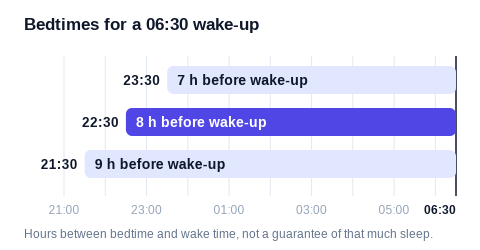
This calculator subtracts fixed sleep-opportunity durations from your wake-up time and shows the resulting bedtime for each duration. It does not predict sleep cycles and does not rank one bedtime as medically better than another. The results are planning examples, not personalized recommendations.
For example, if you need to wake at 06:30 and choose an 8-hour example, the bedtime shown is 8 hours before 06:30 (22:30). That is 8 hours between bedtime and wake time — not a guarantee of 8 hours of sleep.
How much sleep do adults generally need?
The US National Institute of Neurological Disorders and Stroke (NINDS) says most adults need 7 to 9 hours of sleep a night, and that sleep needs vary from person to person. This tool does not diagnose sleep need — it shows time-based examples so you can see what a 7-, 8-, or 9-hour interval before your wake time would look like.
Why it doesn't count sleep cycles
The US National Institute of Neurological Disorders and Stroke (listed in the sources below) says you cycle through non-REM and REM sleep several times during a typical night, with longer REM periods later in the night. The cycles are not identical, so this calculator does not try to estimate or line up with cycle timing.
What this calculator does not consider
- How long it takes you to fall asleep, or time awake during the night.
- Your age, health conditions, medication, or other factors that affect sleep need.
- Sleep disorder screening or diagnosis — it is a planning utility, not a medical assessment.
If you want to understand your actual sleep pattern, try tracking several nights with a simple sleep log — see the Sleep Efficiency Calculator.
Frequently asked questions
How does the bedtime calculator work?
It subtracts a fixed sleep opportunity (7, 8 or 9 hours) from your wake-up time and shows the bedtime for each. If you wake at 06:30 and choose 8 hours, it shows 22:30. That is 8 hours between bedtime and wake time, not a guarantee of 8 hours of sleep.
Does it use 90-minute sleep cycles?
No. You go through several sleep cycles in a night and they are not identical (REM periods get longer later in the night, NINDS says), so the calculator does not try to estimate or line up with cycle timing.
What does the calculator not take into account?
How long it takes you to fall asleep, time awake in the night, your age, health conditions or medication. It is a planning tool, not a sleep disorder screen or a medical assessment.
When to get help
This site offers self-help information, not medical advice, and can't tell you whether you have a sleep condition. Talk to a doctor or other clinician if:
- poor sleep has gone on for a long time or is making your days hard to manage;
- you often feel so sleepy in the day that it's hard to stay awake, especially while driving;
- you or a bed partner notice loud snoring, choking or pauses in your breathing during sleep;
- your mood is low, or you feel anxious or on edge most days.
If you are thinking about ending your life or harming yourself
You don't have to go through this alone. If you are in immediate danger, call your emergency number (911 in the US and Canada, 999 in the UK, 112 in the EU). You can also talk to someone now:
- US:988 Suicide & Crisis Lifeline (call or text)988
- Canada:988 Suicide Crisis Helpline (call or text)988
- UK & Ireland:Samaritans116 123
- Other countries:Find a Helpline (free directory of helplines)findahelpline.com
Sources: NIMH (911, 988), 988.ca (9-8-8, 9-1-1), NHS (999), European Commission (112), Samaritans (116 123, UK and Ireland).
Want to understand your actual sleep?
A short sleep log over a few nights can show how much of your time in bed you actually spent asleep — a different question from bedtime planning.